

What is VoWi-Fi?
The term VoWi-Fi (Voice over Wi-Fi) can be used to describe a number of scenarios in which a telephony service is supported using the wireless technology Wi-Fi. Examples could include using the applications Skype or FaceTime on a mobile or tablet whilst connected to the Internet using a Wi-Fi Hotspot or home broadband connection. However, in this article, we are going to explain how the technology is interconnected with the 4G cellular technology of LTE (Long Term Evolution) and in so doing, enable calls to be seamlessly transferred between the cellular and Wi-Fi radio networks.
Prior to discussing how VoWi-Fi actually works, it is important to briefly explain how voice services have been supported over the various cellular technologies in the past. With regard to the 2G technology of GSM and the 3G technology of UMTS, voice is carried across a circuit switched connection or in other words, a dedicated circuit exists between the calling and called parties for the full duration of the call. 4G or LTE however only supports the transfer of IP packets and as such, it can be referred to as a packet switched network. Therefore, to support voice across an LTE network, it is necessary to encapsulate the digital voice information within an IP packet – a term generally referred to as VoLTE (Voice over LTE). Of note is that this is also the case for 5G, termed VoNR (Voice over New Radio).
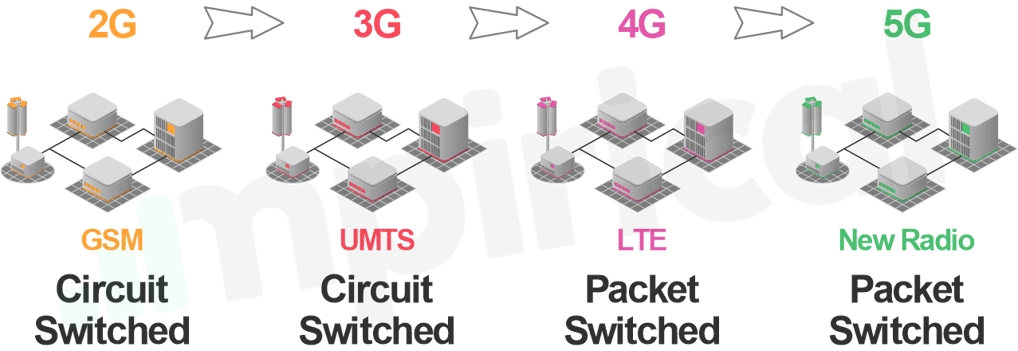
Figure 1 - Delivering Voice over Mobile Technologies
Although the LTE network will be used to carry the voice information contained within the IP packets between the mobile phone and the edge of the LTE network or EPC (Evolved Packet Core), it may be necessary to revert back to circuit switching to support the connection to legacy telephony networks such as the PSTN (Public Switched Telephone Network). This will take place at the edge of the network in a node generally referred to as a Soft Switch. Furthermore, the LTE network will not provide any call control as it is simply a bearer. Instead, subscriber registration and call setup etc. is supported through the addition of an IMS (IP Multimedia Subsystem).
So, how is this associated with VoWi-Fi? Well, most service providers upgrading their networks to support VoLTE typically introduce VoWi-Fi shortly thereafter. The reason for this is that like LTE, Wi-Fi simply provides a bearer capable of supporting VoIP. It must be stressed however that both the network technologies and capabilities are very different. In essence, the mobile will connect to either the Wi-Fi or LTE network depending upon its location, the availability and signal strength of the radio technologies and potential service provider derived optimization rules. Once connected, the mobile will register with the IMS which is agnostic to the underlying bearer technology and should it wish to make or receive a call, the IMS will trigger the establishment of the VoIP connection.
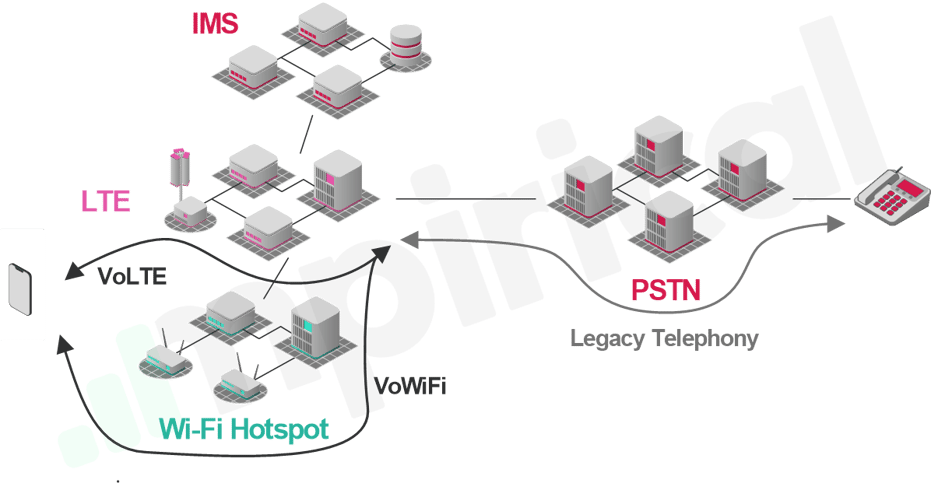
Figure 2 - VoWi-Fi and VoLTE
As the Wi-Fi network interconnects with the LTE core network, VoWi-Fi and VoLTE share a common point of ingress and egress enabling the call to be switched seamlessly as the mobile moves between the two radio technologies. For example, a call may be initiated on the LTE network (VoLTE) whilst the subscriber drives home but will switch to Wi-Fi (VoWi-Fi) when they enter their house and come within range of their Wi-Fi network.
As both Wi-Fi and LTE are simply bearer networks supporting the transfer of IP packets, other services which are capable of being supported on these packet switched networks can also potentially be introduced. This may include video calling or watching the latest Hollywood blockbuster. Like that of voice, video-based services may be initiated on LTE (ViLTE) but transferred over to Wi-Fi (VoWi-Fi) or vice versa (note that ViLTE services are nowhere near as prevalent as VoLTE services).
The final point to note is in relation to 5G. Like 4G, from the outset 5G has been designed to integrate closely with Wi-Fi networks. Since 5G is also a packet data network, the concepts discussed here still apply; that is, a common IMS call control network can still be used for 5G subscribers, based on the fact that 5G is merely providing a packet transport capability. Therefore, future networks will quite possibly see voice full mobility scenarios supported across 4G, 5G and Wi-Fi.
Update
Since this article was published, 3G networks have been switched off across much of the world, including in the UK, where all four major operators have now completed their switch-offs. This makes VoLTE and VoWiFi more important than ever. Devices that don’t support them can no longer fall back to 3G for calls. In places where mobile coverage is poor, such as indoors, basements and rural homes, VoWiFi is often the most reliable way to make and receive calls. 2G is still available as a last-resort fallback for voice on some networks, but it too is due to be switched off by 2033.
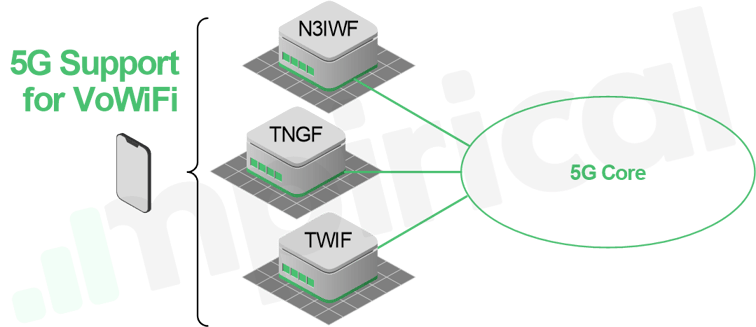
Figure 3 - 5G Functions
At the end of the article, we said that 5G was designed from the outset to integrate closely with Wi-Fi. The 3GPP has since standardised several ways for Wi-Fi to connect directly to the 5G Core:
- N3IWF (Non-3GPP Interworking Function) – used for untrusted Wi-Fi, such as a home broadband connection or a public hotspot that the service provider doesn’t control. The device sets up a secure IPsec tunnel through the N3IWF to the 5G Core. This is the 5G equivalent of the ePDF used for VoWiFi in 4G.
- TNGF (Trusted Non-3GPP Gateway Function) – used for trusted Wi-Fi, where the service provider operates the network or has a trusted relationship with the Wi-Fi provider.
- TWIF (Trusted WLAN Interworking Function) – allows devices that don’t support 5G NAS (Non-Access Stratum) signaling to access the 5G Core over trusted Wi-Fi.
In each case, the device registers with the 5G Core over Wi-Fi in much the same way it would over the 5G radio network.
VoNR (Voice over New Radio), mentioned briefly above, is now live on a number of 5G Standalone networks. Where it isn’t yet available, 5G Standalone devices use EPS Fallback, moving to 4G for the duration of a call so VoLTE can be used. Wi-Fi calling is now standard on almost all smartphones and supported by most major service providers. For many users, it switches on in the background without them ever noticing.
Blog reviewed and updated: October 2026