The Dark Side of AI: What Potential Negative Impact can AI have on 5G?
AI has seen a significant level of hype, growth, and investment globally, with many businesses and employees utilizing it to support their day-to-day operations. In the telecoms sector, mobile operators and network equipment vendors use AI to optimize network performance, automate operations, and accelerate innovation. However, amid the hype and implementation, it’s important to take a step back and acknowledge the potential downsides of AI in Telecoms:
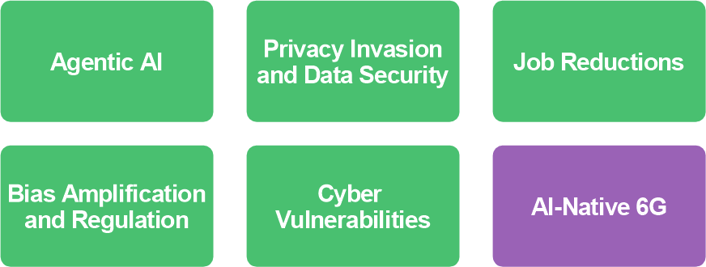
Agentic AI
The newest risk comes from Agentic AI systems that can make and carry out decisions across a network with minimal human input. Telecom infrastructure is heavily regulated and must meet strict reliability standards, so allowing software agents to modify network behaviour raises questions about oversight and safety. Industry voices are already warning about the pace. Red Hat's telecom lead has argued that the industry is not talking enough about the guardrails needed to prevent an AI mishap in networks, pointing to the immediate danger of agents being deployed without safeguards in customer-facing roles where they can access a customer's entire history.
Privacy Invasion and Data Security
AI's ability to process vast amounts of data at lightning speed raises significant privacy concerns. With 5G's enhanced connectivity, there's an exponential increase in the volume of data transmitted across networks. This data encompasses personal information, behavioural patterns, and sensitive business data. The integration of AI algorithms in processing this data heightens the risk of privacy invasion and unauthorized access. From surveillance technologies to targeted advertising, the convergence of AI and 5G amplifies the potential for data breaches and misuse, undermining individual privacy rights and data security.
Job Reductions
The symbiosis of AI and 5G has the potential to streamline the industry in many aspects for mobile operators. However, this digital transformation may come at a cost for employees. AI’s automation capabilities could potentially pose a threat to traditional job roles, leading to widespread role reductions across the sector. Employees may struggle to adapt to the changing skill requirements, leaving them potentially jobless. Just as the Luddites in the 19th century were against the utilization of cost-saving machinery, workers in the modern era may express concerns about the utilization of AI-driven mobile networks, fearing that they will be replaced by them.
The concerns are justified, with BT announcing plans to replace up to 10,000 roles with AI by 2030, targeting network management and customer service. In the US, AT&T cut another 2,100 jobs in the first half of 2026 after cutting 8,000 in 2025, and Verizon's CEO told investors that AI in network operations had already let the company resolve 85% of network issues without manual intervention. However, the picture is not purely an AI story. The telco workforce has been shrinking for years mainly due to automation rather than AI (although AI may have exacerbated this issue), with firms increasingly valuing software, cloud, and automation skills. AI may be as much a convenient justification for cuts as their cause, but for the affected employees, the outcome is the same.
Bias Amplification and Regulation
Studies have shown that results generated by AI do not just reproduce biases in data; they can amplify them. This can create unjustifiable differences in model accuracy between geographically dispersed regions. For example, if a model is trained on data primarily from one region for network optimization, it may perform less accurately when used in other regions, resulting in a poor user experience. On the topic of regions, we also need to consider how AI is regulated globally. Operators may find themselves caught between different jurisdictions and, in some cases, there may be regulations that are contradictory, resulting in an increased level of complexity in implementing AI.
The EU's AI Act was meant to impose high-risk obligations from August 2026, but the Digital Omnibus on AI entered into force on 27th July 2026, pushing compliance for standalone high-risk systems to 2nd December 2027 and for AI embedded in regulated products to 2nd August 2028. Meanwhile, other jurisdictions are writing their own rules for agentic systems. In January 2026, Singapore's IMDA published a Model AI Governance Framework for Agentic AI, adding to the patchwork operators must navigate.
Cyber Vulnerabilities
Many discussions exist about how AI can be utilized to better understand and implement security features within 5G and many other domains, but discussions are limited surrounding how AI can be applied by malicious actors to orchestrate sophisticated cyber-attacks. From a knowledge perspective, AI lowers the bar, allowing less skilled adversaries to carry out cyber-attacks. It can provide malicious actors with a range of AI-generated features such as malicious payloads, customized phishing emails, and vulnerability identification techniques. The convergence of AI and 5G amplifies the complexity and scale of cybersecurity threats.
In November 2025, Anthropic reported that a Chinese state-sponsored group had manipulated its Claude Code tool to support reconnaissance, vulnerability discovery, exploitation, lateral movement, credential harvesting and exfiltration largely autonomously, with AI executing around 80% to 90% of the attack tasks independently. Telecoms remain a prime target. The Salt Typhoon campaign against telecom networks is still active: in February 2026, Norway confirmed a compromise, and Singapore confirmed all four national telecoms had been breached. As operators hand more control to AI agents, those agents become targets themselves. Attackers don't need to compromise the network directly; they only need to trick a trusted agent into accessing it for them.
Looking Ahead: AI-Native 6G
While 5G networks have AI bolted on, 6G is being designed with AI in mind, with commercial rollout widely expected around 2030. AI could manage everything from how signals are transmitted to how the network heals itself, making model failures, bias or manipulation a threat to basic connectivity rather than a performance issue. 6G's expected sensing capabilities, which let the network detect movement and location, add a new layer of privacy concerns. The time to design safeguards, explainability and human oversight into 6G is now, while the standards are still being written, rather than after deployment.
Conclusion
In conclusion, the integration of AI and Telecoms still holds massive potential for innovation. But in 2026, the risks are no longer hypothetical. AI agents are starting to run parts of networks, jobs are being cut in AI's name, regulation remains a moving target, and AI-driven cyber-attacks are now documented. The convergence of AI with 5G, and soon 6G, remains a double-edged sword.
To explore how security is being addressed within 5G networks, including AI-driven threat vectors, take a look at our 5G Security course.
If you would like to get a taste of our on-demand telecoms training, sign up to our 48-hour Free Trial. Gain access to our Learning Portal, 4 course modules and our learning tools NetX, NetXpert and NetXplore.
Blog reviewed and updated: October 2026