

Understanding the Three Pillars of AI-RAN
Introduction
Mobile networks are entering a new phase in which AI is becoming a core part of how the Radio Access Network is used, extended, and evolved. This broader shift is captured by AI-RAN, which looks beyond optimisation alone to reimagine the RAN as both an intelligent system and a programmable platform.
AI-RAN brings together three complementary use cases. AI for RAN applies machine learning directly within the network to improve efficiency, performance, and automation. AI on RAN focuses on running AI-driven applications at the network edge, leveraging the RAN's proximity to support low-latency services for users and devices. AI and RAN explores shared infrastructure models, where compute, acceleration, and networking resources can be exposed as a service, allowing AI workloads to run alongside traditional RAN workloads.
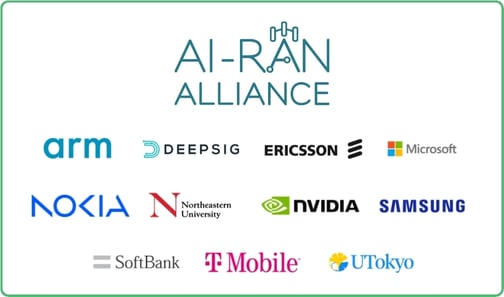 AI-RAN and the AI-RAN Alliance
The AI-RAN alliance was established in 2024 as a collaborative industry effort to accelerate the integration of AI into Radio Access Networks. The alliance comprises several key industry and academic stakeholders, including operators, equipment manufacturers, and research institutions.
The alliance focuses on developing common frameworks, reference architectures, and shared best practices that enable AI to be deployed in a practical, interoperable, and scalable way across the RAN. By working collectively, members aim to reduce fragmentation, align technical direction, and create a stronger ecosystem for AI-driven innovation in mobile networks.
AI-RAN Use Cases
AI-RAN uses general-purpose accelerated computing platforms built on software-defined and AI-native principles. This approach contrasts with traditional RAN architectures that rely on specialized, purpose-built hardware. Through modern CPUs (Central Processing Units), GPUs (Graphics Processing Units), and AI accelerators, AI-RAN enables networks to handle both traditional telecommunications workloads and complex, demanding AI workloads on the same infrastructure. This convergence opens new possibilities for network efficiency, service innovation, and revenue generation.
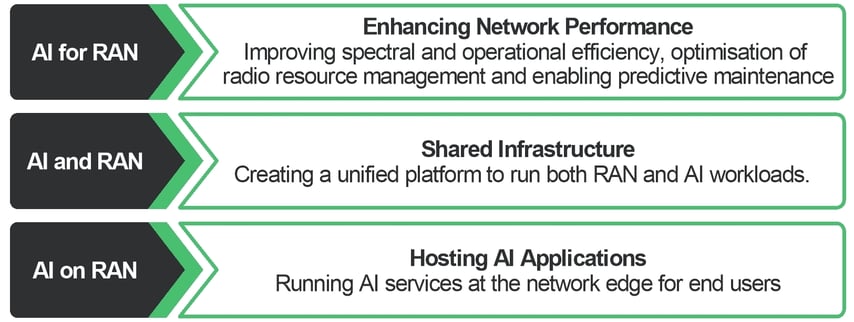
The vision for AI-RAN extends beyond incremental improvements to existing networks. It encompasses a fundamental reimagining of telecommunications infrastructure where AI is embedded at every level, from low-level radio signal processing to high-level network orchestration. As the industry looks towards 6G, AI-RAN represents a critical stepping stone toward ultra-responsive, intelligent networks that can support emerging applications, such as extended reality, digital twins, and autonomous systems.
AI for RAN: Intelligence at the heart of the RAN.
AI for RAN focuses on applying AI and ML models within the radio signal-processing chain to enhance network performance. In this domain, AI algorithms are embedded directly into radio signal processing functions to optimize operations like channel estimation, resource allocation, beamforming, and power control. The goal is to enhance spectral efficiency, increase network capacity, reduce latency, and minimize energy consumption. AI for RAN represents an evolution of existing RAN capabilities, augmenting traditional algorithms with machine learning models that can adapt to complex, dynamic radio environments. This domain addresses the core challenge of managing radio resources more intelligently in increasingly congested spectrum environments.
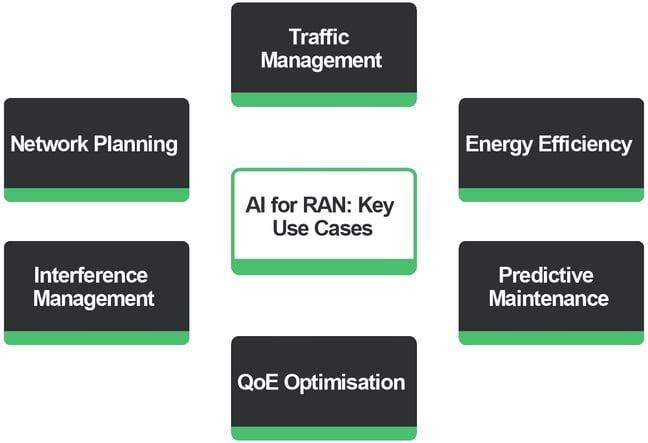
Essentially, AI for RAN is an application of AI that is directly used as part of the operation and optimization of the RAN itself. At the technical level, this involves deploying machine learning models that process radio measurements, network telemetry, and other inputs to make real-time decisions about network operations. These models may employ techniques ranging from classical machine learning algorithms, such as decision trees and support vector machines, to deep learning approaches, including neural networks, recurrent neural networks for time-series prediction, and reinforcement learning for optimisation problems. The specific techniques employed depend on the use case, the available data, and the latency requirements for decision-making.
AI and RAN: Maximising infrastructure value beyond connectivity.
The term AI and RAN (also known as AI with RAN or RAN-Infra as a Service) enables both AI and RAN workloads to run concurrently on a single platform. This is made possible by the convergence of telecoms and general IT hardware; telecoms networks no longer require specialized, proprietary equipment, allowing more general-purpose computing platforms to be used. Operators can deploy a unified platform centred on GPUs and AI accelerators to handle both types of workloads simultaneously. The overall goal is to maximize resource utilization and provide opportunities to monetize spare capacity.
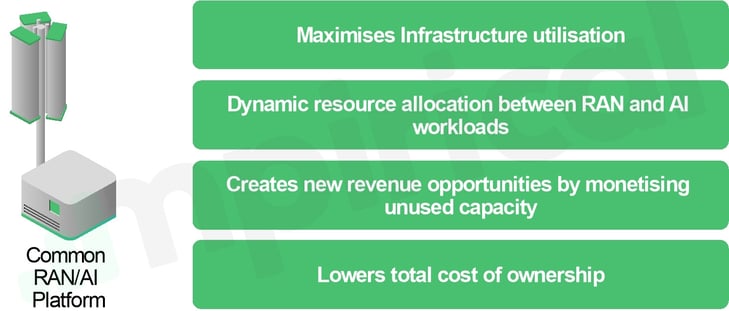 Figure 4 - AI and RAN Key Benefits
Figure 4 outlines some of the key benefits, but it is worth noting that these AI workloads may run at a base station site or in a local data centre. Ultimately, the goal is to maximize the use of computing capacity without impacting the operation of processing required in the RAN.
The success of AI and RAN converged platforms depends on sophisticated and carefully balanced resource management. Compute, memory, and network resources must be allocated dynamically between traditional RAN functions and AI workloads without either side suffering performance degradation. This is challenging because RAN functions operate under strict real-time constraints, while AI applications often have more flexible, service-driven demands that can vary widely in scale and priority.
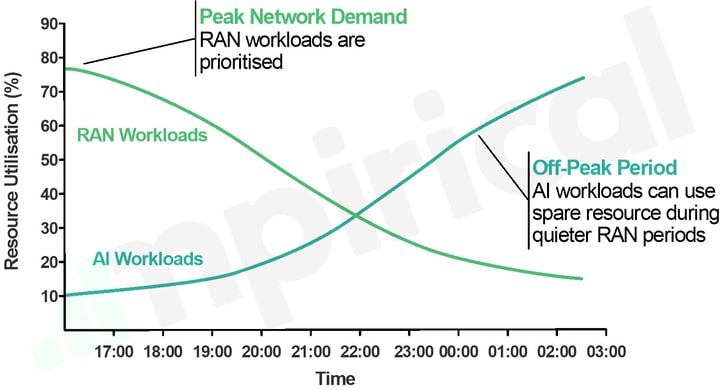 Figure 5 - AI and RAN - Resource Orchestration & Management
In an AI on RAN environment, resource management involves ensuring that AI applications have timely access to the necessary resources and data, without compromising the operation of the RAN. Intelligent orchestration systems continuously monitor network load and application requirements, adjusting resource allocation in real-time. This enables the RAN to support AI applications that depend on live context information, such as environmental data, device location or user interaction, while maintaining the performance expected of mobile services.
AI on RAN: A platform for next-generation AI applications at the edge.
AI on RAN represents an opportunity for operators to maximize the efficiency of their compute resources by providing a platform for AI applications and services to run alongside traditional RAN processing. Where AI and RAN focuses on the use of RAN infrastructure to support specific AI workloads, such as training or inference, AI on RAN provides a platform for AI-driven applications and services operating at the very edge of the network. In this model, the RAN offers more than just connectivity; it becomes an intelligent environment that enables applications with stringent latency and data transfer requirements.
AI on RAN enables a wide range of applications and services that benefit from, or depend on, edge processing, particularly those that are highly latency-sensitive and require deployment as close to the end user as possible. A key distinction between AI on RAN and standard edge solutions, such as MEC (Mobile Edge Computing), is that in the RAN case, the operator hosts the AI workload on their own compute resources, integrated within the RAN infrastructure. This differs from simply co-locating resources at the RAN site or in a nearby data centre, highlighting the business potential for operators to offer public computing capacity on infrastructure that has traditionally been private and closed.
Figure 6 highlights some key use cases for AI on RAN
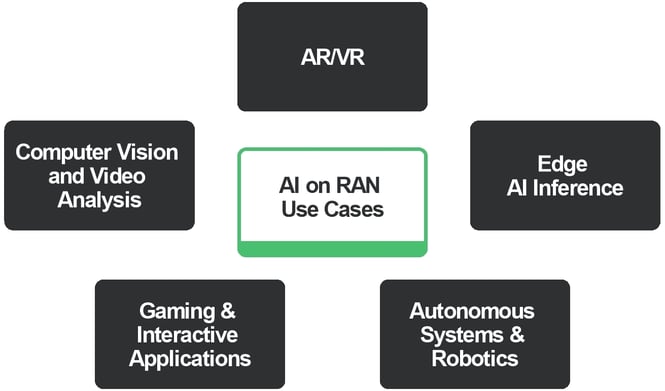 Figure 6 - AI on RAN Use Cases
Taken together, the three AI-RAN use cases point towards a future where the Radio Access Network is not only more intelligent, but also more open, flexible, and programmable. As AI becomes embedded across network operations, infrastructure, and edge services, AI-RAN provides a common framework for rethinking the RAN's role in the broader digital ecosystem.
The work of the AI-RAN Alliance is likely to play an essential role in shaping this future. By aligning industry stakeholders around shared architectures, use cases, and technical direction, the alliance is helping to turn practical experience into guidance that can inform formal standardisation efforts. Over time, this collaboration is expected to influence how standards bodies define AI-enabled RAN capabilities, ensuring that future networks are built on proven, interoperable, and scalable approaches.